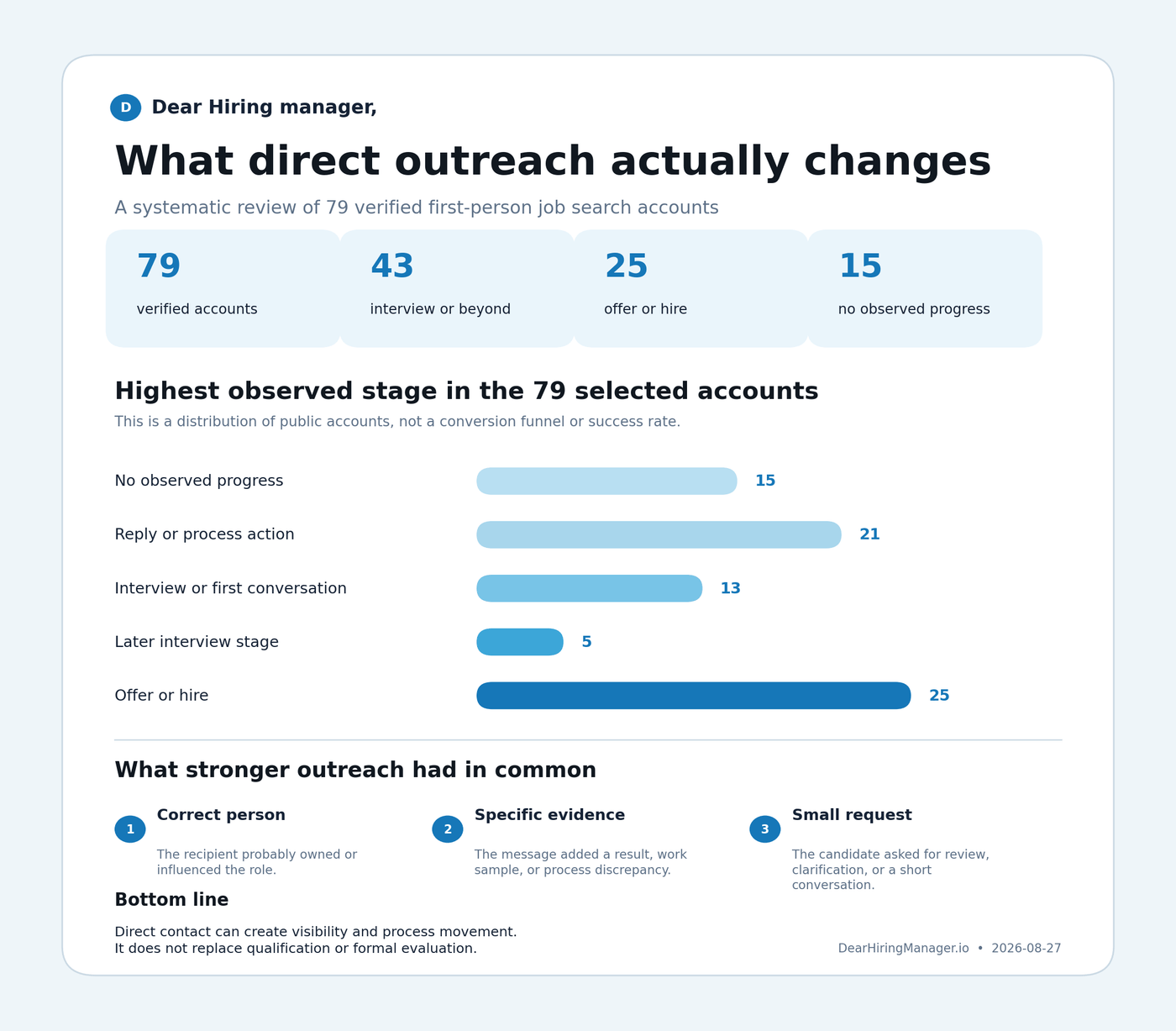
We reviewed 79 verified first-person job search accounts in which a candidate contacted a hiring manager, recruiter, department head or another person involved in the decision, and reported what happened next. The result is not a universal success rate: nobody ran a randomised experiment, and people are more likely to publish unusually good or unusually bad outcomes. What the evidence can show is where direct outreach acts, where it stops, and what the stronger messages have in common.
Should you email the hiring manager after applying?
Usually yes, when all four of these are true:
- You have identified the person who probably owns the role.
- Your background is plausibly relevant to the job.
- Your message adds one useful fact, proof point or question.
- You can keep it short, send it once, and accept silence.
It is less useful when the recipient is only loosely connected to the opening, when the message just says that you applied, or when the process has already produced a considered rejection with no error in it.
Contacting the hiring manager is a visibility and routing tactic. It can cause a person to inspect, forward, correct or discuss an application. It cannot make the candidate pass the rest of the evaluation.
If you already know you want to send the message, the practical guide to emailing a hiring manager after applying has the timing and the templates. This page is the evidence behind that decision.
What happened in the 79 verified accounts
Every account was coded by the furthest observable result after direct contact. The five categories are mutually exclusive, so each story appears exactly once, in the highest stage it reached.
- No observed progress15
- Reply or process action21
- Interview or first conversation13
- Later interview stage5
- Offer or hire25
- 15 showed no observed progress — silence, a negative response, or confirmation that the candidate would not advance.
- 21 produced a reply or a process action without a reported interview: a status update, feedback, a corrected record, a resume review, or a handoff back to recruiting.
- 13 reached a first interview or a comparable initial conversation.
- 5 reached a later interview stage without reporting an offer.
- 25 described an offer, contract or hire.
These counts are not a 32% offer rate. The denominator is a selected set of publishable accounts, not every message job seekers send. What is informative is the shape of the distribution: direct contact appears at every outcome level, from complete silence to employment. The tactic has no automatic result. Its value depends on what problem the message is able to solve.
The main effect is getting a human to inspect the application
High-volume postings and applicant tracking systems create one specific problem: a qualified application may never get careful human attention. Direct contact creates a second path to that attention, and in these accounts it did three distinguishable things.
| Function | What it looks like in the accounts |
|---|---|
| Visibility | A decision maker opens an application that would otherwise have stayed in a queue. |
| Routing | The manager forwards the candidate to the correct recruiter, or asks for a review. |
| Error correction | The contact exposes a missing document, a mistaken rejection, a paused role or a lost application. |
The mechanism is visible even when the answer is no. In one account a candidate applied for a role that closely matched their current work, contacted the manager, and was told plainly that the experience was not considered sufficient. The outcome was negative, and the application still moved from an opaque system decision to a human assessment.
In another, a candidate contacted the hiring manager after a week without news and got an interview. A different candidate got no answer to the email, called the office a week later, and then secured an interview — which is worth keeping in view, because the combined outreach worked while the email alone did not produce the observable result. One candidate learned that an application had been rejected because a required questionnaire never arrived. The contact exposed the process failure even though it did not reverse the result.
All three functions are valuable, and none of them guarantees an interview. If your applications are vanishing before any human sees them, how to bypass ATS covers the filter that is usually eating them, and why you are not hearing back covers what silence normally means.
An interview is evidence of progress, not proof the message caused it
In 18 accounts the highest reported result was an interview or a later stage without an offer, and 25 ended in an offer, contract or hire. Combining them gives 43 accounts that reached an interview or beyond. That is descriptively correct inside this corpus, and it still does not establish causation.
Many candidates used several tactics at once: tailoring the resume, preparing a role-specific work sample, asking an employee for a referral, following up by phone, contacting someone they already knew, replying to the manager's own job announcement, or improving the application after an earlier rejection. We coded 70 of the 79 accounts as direct attribution and 9 as bundled or uncertain, and even the direct ones are self-reported.
That makes the finding more practical rather than less. The strongest outreach was rarely a substitute for a good application. It was a delivery mechanism for evidence that made the application easier to evaluate.
Strong outreach adds information the application did not communicate
The persuasive accounts share one feature: the message gave the recipient a reason to do something.
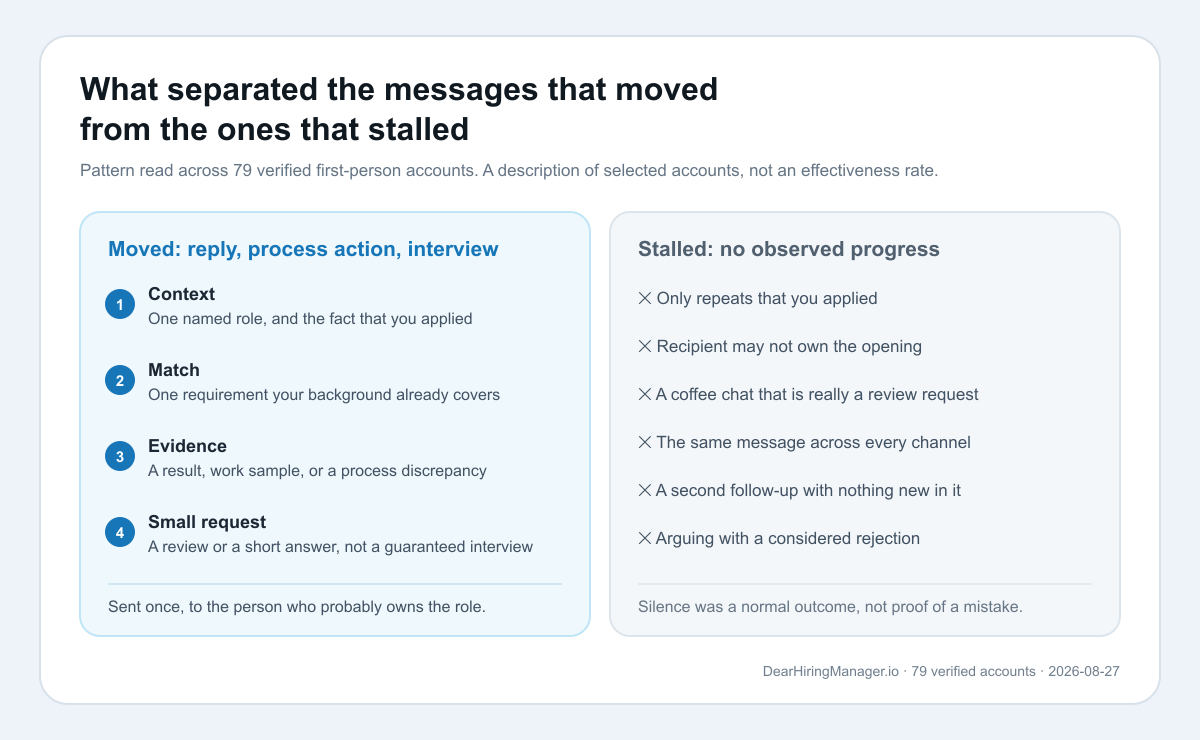
A relevant work sample. One candidate described sending a role-specific work sample after applying, alongside a resume rewritten around the posting, and was eventually hired. The lesson is not that applicants should produce free work. It is that the message contained something checkable instead of enthusiasm.
A precise connection to the role. Another candidate researched an organisation, prepared a short deck tied to the opening, and contacted the decision maker after applying. The executive replied. The observable outcome stopped at a reply, and the mechanism is still clear: relevance created a reason to engage.
A response to the manager's own hiring post. When the decision maker has publicly discussed the opening, identity and context are already settled. One candidate replied to a manager's job announcement and received a calendar invitation. That is structurally different from guessing which of several department heads owns a role.
A credible reason to re-examine an automated rejection. Several candidates made contact after a rejection that looked inconsistent with their experience or with what they had been told. Sometimes the rejection was confirmed; sometimes the contact uncovered an error and restarted the process. The stronger version of this message never argues that the company owes anyone a job. It names a specific discrepancy — the role matches the candidate's current responsibilities, required materials appear not to have been reviewed, the candidate was a finalist for a similar opening, the rejection contradicts something said during the process — and gives the recipient a narrow question they can answer.
Generic interest is not a reason to reply
The weakest messages repeated what the application already said: I applied and wanted to express my interest. It is polite, and it creates work for the recipient without adding evidence. The manager still has to find the application, infer why this person might fit, and decide what to do.
In one account, six hiring managers accepted connection requests and none replied to the follow-up. In another, a candidate sent several emails with a resume and cover letter and observed one profile view.
Silence does not prove the message was inappropriate — the manager may have been busy, the role may have been paused, the candidate may already have been screened out. It does show that contact alone is not a value proposition. A stronger message answers three questions immediately: which role is this about, why might this candidate deserve a closer look, and what small action is being requested.
The correct person matters more than the perfect wording
Most job seekers treat outreach as a copywriting problem. The evidence suggests identification matters at least as much. A concise message to the person who owns the opening can be useful; the same message to an unrelated director is ignored because that person has no context, no access and no responsibility for the role.
| Person contacted | Accounts |
|---|---|
| Hiring manager | 70 |
| Recruiter | 5 |
| Department head | 2 |
| Executive or company contact | 2 |
Before contacting anyone, verify as much of this as you can:
- the person manages the relevant function or team
- the role probably reports into that person's organisation
- the person still works at the company
- the company is the employer, not an external recruiting agency
- the opening is still active
- the contact route is professional rather than personal
Titles alone are not enough. A global head may sit several levels above the real decision; a recruiter may own the process without doing the functional assessment; a team lead may be closest to the work and uninvolved in the search. The manual method is in finding the hiring manager's name and email, and the difference between the two roles is in hiring manager versus recruiter. If you would rather not do it by hand, DearHiringManager.io takes the job posting URL and identifies the likely decision maker behind that specific opening, with a verified email and LinkedIn profile.
When candidates contacted the decision maker
- Before or around the application16
- After applying, before an interview28
- After an interview or late in the process18
- After a rejection12
- Other or unclear5
This distribution is not a test of which moment works best. It reflects which stories were available and verifiable. What changes across the stages is the goal of the message.
Before applying: only with a specific reason to write
The message tests fit, creates early visibility, or asks where to apply. It works when there is a specific reason to write to that person: a public job post of theirs, a niche background, an unusual work sample.
After applying: the window most people are asking about
The largest group, 28 of 79, and the one behind the question most people are actually asking. The message should name the role, state that the application is in, and add one concise proof point.
After an interview: ask about the process, not the decision
The goal shifts from visibility to process clarification: a missed timeline, requested information, a scheduling problem. A follow-up here often reveals a delay, a freeze, or a decision already made.
After a rejection: a question can expose an error, an argument cannot
Most defensible when there is a concrete reason to suspect an error, or when you want brief feedback. Some post-rejection contacts in the corpus led to renewed interviews or corrected decisions; others only confirmed the rejection. The asymmetry is the point — a short respectful question can expose a mistake, repeated argument cannot create one.
Email or LinkedIn?
The evidence does not support a reliable claim that one channel beats the other. Both appear in successful and unsuccessful accounts.
| Channel | Accounts |
|---|---|
| 38 | |
| 17 | |
| Direct message, channel unstated | 20 |
| In person, phone, or forwarded by an employee | 4 |
Email leads the count, and a fifth of the accounts do not name a channel at all, so treat this as a description of what people wrote down rather than a performance comparison. The channel is entangled with everything else that matters: whether the right person was identified, whether the account was monitored, whether the manager had posted the role, whether the message carried evidence, whether a warm connection existed.
Choose the channel that makes the professional context clearest. Email is useful when the address is public or verifiable and you need to attach a document or work sample. LinkedIn is useful when the manager posted the opening, you share a connection, or the identity is clear but the address is not — the wording for that is in what to message a hiring manager on LinkedIn. Do not send the same message across every channel you can find. One good message, and at most one later follow-up, is the defensible default.
Can contacting the hiring manager bypass the recruiter?
Usually not, and bypassing recruiting should not be the goal.
Managers can express interest, ask for a resume review, or ask recruiting to schedule a conversation. They still work inside a process built for compliance, compensation, assessment and recordkeeping. A recurring sequence in these accounts runs: the candidate contacts the manager, the manager shows interest, the manager routes the candidate to recruiting, and the candidate still has to pass the screen and the interviews. In some stories they did not pass. The outreach was not wasted — it did the thing it can do, which is create consideration.
The practical objective is to add a second route into the process, not to remove the people running it.
A five-part test before you send
- Identity. Can you explain why this person probably owns or influences the role? Seniority is not evidence of ownership.
- Fit. Can you state one concrete reason your experience maps to the job? A result, customer segment, system, market or responsibility beats years of experience.
- Added information. Does the message contain something the application does not communicate quickly — a work sample, a quantified result, a prior interaction, a possible application error?
- Small request. Are you asking for a proportionate next step? Reviewing the application, confirming the right owner, or a short conversation. Not a guaranteed interview.
- Restraint. Can you send it once and accept silence?
If all five hold, the downside of one concise professional message is usually limited. If the first three are weak, rewriting the sentence will not fix the underlying problem.
What to say after applying
A research-based message needs context, relevance, evidence and a small request. It does not need a clever subject line.
Subject: Applied for [Role] | [relevant specialty]

  Hi [Name],

  I applied for the [Role] position today. I noticed the team is
  looking for someone who can [specific responsibility]. In my
  current role I [one relevant result or proof point].

  I've included [a short example, portfolio item, or one-sentence
  connection] in case it is useful when reviewing applicants. If
  you are the right person for this search, I would appreciate
  your consideration.

  Best,
  [Your name]
Short version, for a direct message:
Hi [Name], I applied for the [Role] position. My background in
  [specific area] looks closely connected to the team's need for
  [specific responsibility], particularly [one proof point]. Sharing
  that context in case it is useful during review.
Neither version asks the manager to bypass recruiting. Both give them enough to decide whether the application deserves attention. More variants by situation are in 12 sample emails to a hiring manager.
When not to contact the hiring manager
Do not send a message merely because you found an address.
- the posting explicitly says not to contact employees about the opening
- the only address or account available is clearly personal
- you cannot identify any meaningful connection between the person and the role
- the message would only repeat that you applied
- you have already sent several unanswered messages
- the team gave a clear final decision and there is no specific error to investigate
- you would be using the message to pressure, accuse or demand
Some candidates succeeded through persistence, and that does not make every form of persistence appropriate. Public outcome stories reward unusual behaviour, because unusual behaviour is what gets posted.
What the 25 offer and hire accounts really mean
They establish an existence claim: direct contact can form part of a successful path into a job. They do not establish an average effect. The successful accounts often carried additional advantages — an unusually close fit, a warm introduction or prior relationship, a role-specific artifact, a reply to a manager's public hiring post, a corrected process error, or several interview rounds after the first contact.
Of the 79 accounts, 20 were explicitly cold, 6 carried a warm element such as a referral or a prior finalist relationship, and 53 do not say. That last number is why we do not publish a cold-versus-warm comparison: most authors simply never mention it, and a referral is a different mechanism that should not lend its results to a cold email.
Direct contact can create a real opportunity when it gives the correct person credible information and an easy next action. The candidate still has to survive the rest of the hiring process.
Methodology
Design and research question
This is a systematic content analysis of public first-person job search accounts, not a survey or an experiment. The question was: in public first-person accounts, what observable outcomes follow when a candidate directly contacts a hiring manager, recruiter, department head or another decision maker about a specific opening?
Where the accounts came from
Two public platforms: Reddit, where job seekers write a search up at length in topic communities, and X, where the same events get reported in a sentence or two. Nothing was collected from private groups, direct messages, or any source behind a login.
Discussions were retrieved with several search families covering phrasings such as emailed the hiring manager, reached out to the hiring manager, contacted the hiring manager, messaged the hiring manager, cold emailed a recruiter, contacted someone after applying, and contacted someone after rejection. Long-form threads and their comments were read for detailed accounts; short posts were kept only when both the action and the outcome could be established from the text itself. Most of what those searches surfaced never became a row: opinion, advice, hypotheticals and complaints with no reported outcome were all read past.
What we publish is the coded evidence rather than the raw retrieval log, so this page deliberately does not quote a “screened X, kept Y” ratio it cannot show you. Every unit that did get in carries its source URL, so any row can be opened and checked against the original.
The corpus in numbers
| Measure | Count |
|---|---|
| Coded evidence units (separate statements) | 90 |
| Distinct source pages behind them | 87 |
| Standalone posts / comments inside threads | 75 / 15 |
| Reddit units, across 14 communities | 37 |
| X units, from 53 separate accounts | 53 |
| Publication years covered | 2011–2026 |
| Units published in 2023 or later | 48 |
| Candidate experiences in the outcome denominator | 79 |
The 79 candidate experiences come from 76 distinct source pages: one post walked through three separate episodes and one comment described two, and each episode was coded on its own. On the X side the ratio is exactly one account to one unit, so no individual is counted twice. On Reddit the units cluster where the topic lives.
- r/recruitinghell14
- r/jobs4
- r/EngineeringStudents3
- r/Switzerland3
- Ten other communities13
That concentration is a bias worth naming rather than hiding: r/recruitinghell exists to document bad hiring experiences, so the corpus over-represents people who already had a reason to be angry with a process — and it still contains 25 accounts that ended in an offer or a hire.
Unit of analysis
One candidate experience, not one post. Repeated descriptions of the same event by the same person were deduplicated into a single experience; a discussion containing several distinct experiences could yield several units.
Inclusion and exclusion
An account was included only when it contained a specific opening, candidate-initiated contact with someone involved in hiring or able to route the application, an observable reported outcome, and enough context to distinguish the contact from an ordinary application. Excluded: advice without a personal event, hypotheticals, cases where the company made contact first, generic recruiting interactions unrelated to a specific opening, duplicates, and promotional claims that could not be tied to a clear experience.
Coding
Each account was coded for contact target, relationship context where observable, channel, timing, observed outcome, highest stage reached, and whether attribution was direct or bundled. Outcomes were normalised onto five mutually exclusive stages, and the highest observed stage was used — an account describing a reply, an interview and then an offer appears only under offer or hire.
Final sample
| Type of account | Units |
|---|---|
| Candidate accounts with an observable outcome | 79 |
| Hiring-side perspectives | 7 |
| Mixed aggregate accounts | 3 |
| Comparison case without decision-maker contact | 1 |
Only the 79 candidate accounts enter the outcome distribution. The hiring-side, aggregate and comparison units are contextual and are published in the same file so they can be inspected rather than taken on trust. By platform, 53 units came from X and 37 from Reddit.
Identification is deliberately uneven. X units keep the account handle, because on that platform the post and the identity are the same public object. Reddit units are identified by thread rather than by username. Either way this article describes patterns and names no job seeker: nobody posting about a rejection signed up to be a case study with their handle attached.
Why no effectiveness rate is published
The sample is non-random and selected several times over: people choose whether to publish an experience, unusual outcomes get discussed more, stories containing clear outcome words are easier to retrieve, silent failures often leave no record, and detailed accounts are likelier to pass the inclusion criteria. The share of stories ending in an offer therefore cannot estimate the probability that your next message produces one.
Other limitations
- Accounts are self-reported and were not verified with employers; some outcomes may be remembered incompletely.
- Contact often happened alongside resume changes, referrals, work samples or phone calls, which limits causal attribution.
- The corpus is English-language public discussion and may not generalise to other labour markets, occupations or communication norms.
- Unopened messages, private conversations and the people who decided not to contact anyone are invisible to this method.
Frequently asked questions
Should I email the hiring manager after applying online?
Yes, when you can identify the person who probably owns the role and add a specific reason to review your application. In the accounts we coded, 28 of 79 contacts happened after applying and before an interview, and the ones that produced movement carried a result, a work sample, or a concrete question. A generic note saying that you applied is much less likely to create value.
How long should I wait before contacting the hiring manager?
There is no defensible universal delay in this evidence. If your message adds context to an application you just submitted, it can be sent shortly after applying. If you are following up on a decision the company promised by a date, wait until that date has passed.
Is it better to contact the recruiter or the hiring manager?
Contact whoever can solve the current problem. Recruiters own process, scheduling and application status. Hiring managers are better placed to judge functional relevance and team fit. In 70 of the 79 accounts the person contacted was the hiring manager, and direct contact frequently routed the candidate back to recruiting anyway.
Does messaging the hiring manager on LinkedIn work?
It sometimes produces a reply or an interview, but these accounts do not show that LinkedIn beats email or the reverse. Email appeared in 38 accounts and LinkedIn in 17, with 20 more describing a direct message without naming the channel. Identity, relevance and message content are bundled together with the channel, so the channel cannot be isolated.
Can emailing the hiring manager hurt my application?
One concise, professional message about a specific opening has limited obvious downside in ordinary cases. What damages the impression is repeated contact across every channel, messages to personal accounts, pressure or accusation, and ignoring an explicit instruction in the posting not to contact employees.
What if the hiring manager does not reply?
Silence was a normal outcome: 15 of the 79 accounts recorded no observed progress at all, and a profile view or an accepted connection may be the entire visible result. Do not read it as a verdict on your candidacy. Keep the wider search moving, and send at most one concise follow-up once a reasonable timeline has passed and the role is still open.
Should I contact the hiring manager after a rejection?
Do it when you have a specific question, a plausible process discrepancy, or a short request for feedback. Twelve of the 79 accounts were post-rejection contacts; some exposed an error, a missing document or a mistaken notice, and others simply confirmed the decision. Asking a narrow question works, arguing that the decision must be reversed does not.
Can I skip the recruiter by going directly to the manager?
Usually no. A manager can create attention, request a review, or ask recruiting to prioritise a candidate, but most companies still require their formal process for assessment, compensation and recordkeeping. The realistic goal is a second route into the process, not a way around the people running it.
Using this data
The dataset is free to quote and republish with a link to this page. Do not convert the coded outcome counts into a success rate. The released file includes the source URL, timing, target, channel, coded outcome and an analytical note for every unit, as CSV or JSON.
DearHiringManager.io, “Does Emailing the Hiring Manager Work? 79 Real Job Search Outcomes Analyzed,” snapshot of 2026-08-27. 79 verified first-person accounts of contacting a hiring decision maker, coded from 90 evidence units. https://dearhiringmanager.io/hiring-manager-outreach-study
Found an error, or want a cut we did not publish? Write to team@dearhiringmanager.io and it gets corrected with the date of the change.
The practical conclusion
Messaging the hiring manager is not a hiring hack. It is a way to reduce the chance that a relevant application stays invisible or misunderstood. Three conclusions survive the caveats:
- Direct contact can produce real process movement — reviews, corrected decisions, interviews, offers and hires.
- The strongest messages add role-specific evidence or name a concrete process problem.
- The message does not replace qualification, assessment, headcount approval or recruiting operations.
Use it when you have the right person, a credible fit and something useful to add. Treat the result as one intervention in a larger search.
Find the likely decision maker for this job. Paste the job URL into DearHiringManager.io to identify the person most likely to own the role, with a professional way to contact them — so the hour you have goes into the message rather than the search.
Related reading: The Outreach Index, job search statistics 2026, the practical guide to emailing a hiring manager after applying, and finding the hiring manager's name and email.